The test every theory has to pass
Any explanation of the image has to produce all of these at once: Documented STURP 1981 Heller and Adler
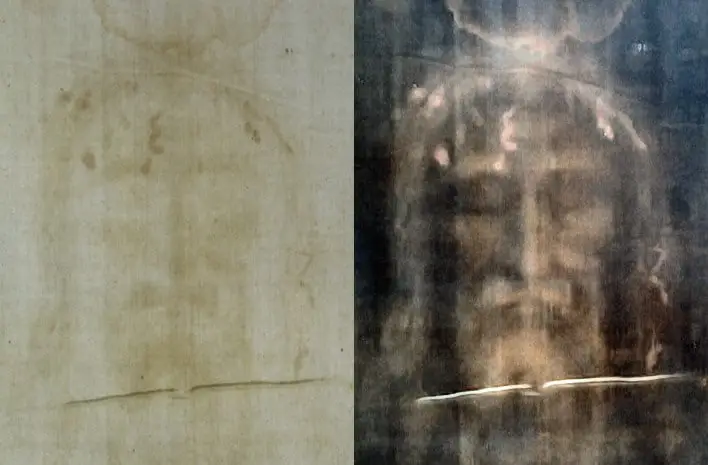
- A photographic negative with lifelike gradation.
- Three-dimensional encoding: density that tracks cloth-to-body distance.
- Color on the topmost fibers only, with no soaking or wicking.
- No pigment, dye, binder or applied material.
- No directionality.
- A halftone: equal color per fiber, tone by count.
- No image under the blood.
- No fluorescence under ultraviolet, where scorches fluoresce.
- Front and back images of equal density, unaffected by the body's weight.
No proposed mechanism from any camp has produced all nine on a full-size cloth. Each reproduces a few. (A tenth test, the anatomical accuracy of the wounds, is an argument rather than a measurement; it is made on The Case Against.) This page lists them by camp. The order is not an argument.
Artifice
Painting. Walter McCrone's claim: iron oxide and vermilion in a collagen tempera, applied by an artist around 1355, with the blood painted in. Fails on 4 (the project found no binder and the color is in the fiber), 3 (paint sits on fibers), 5 and 7. McCrone's reply was that the amounts were tiny and the project's chemists were wrong. Claimed McCrone Heller and Adler
Bas-relief rubbing. Joe Nickell, 1978 onward: cloth laid over a carved relief, pigment or a dry powder rubbed on so the high points take the color, producing a negative automatically. Reproduces 1 and a degree of 2. Fails on 3, 4, 5 and 7, and on the resolution of the face. Whether a rubbing gives a Shroud-like VP-8 result is argued between Nickell and Jackson. Claimed Nickell
Bas-relief with acid. Luigi Garlaschelli, 2009: cloth over a bas-relief, rubbed with a pigment containing acid, baked, washed, blood added afterward. A full-size reproduction, funded by the Italian skeptics' group CICAP. Reproduces 1 and a rough 2. Critics: the blood is in the wrong order (7), the image is coarser, the color chemistry differs, and the three-dimensional result is "grotesque." Garlaschelli's own position was that it showed a medieval forger could have done something similar, not that this is how it was done. Claimed Garlaschelli
Proto-photography. Nicholas Allen, 1990s: a camera obscura with a quartz lens, a corpse or statue in the sun for days, and silver salts on the cloth. Reproduces 1 and 2 remarkably well. Fails on 4 (no silver found, though the 1978 X-ray method could not have detected it well) and on history: it requires a fourteenth-century inventor of photography who used it once, left no trace and sought no profit. Rock-crystal lenses did exist in the Middle Ages. Claimed Allen Visby
Scorch from a heated statue. Proposed by several authors: a heated bronze or stone relief pressed to the cloth. Fails on 8 (scorches fluoresce; the image does not), on 3 (heat penetrates), and on 2 in detail. Claimed Miller and Pellicori
Digital modelling of a low relief. Cícero Moraes, 2024 to 2025: computer draping of cloth over a body and over a low relief suggests the undistorted proportions of the image fit a low relief better than a wrapped body, which would show the "Agamemnon mask" spreading. Challenged in 2026 on method by authors who favor authenticity. This is a geometric argument, not a production method. Contested Vatican News 2026
Natural processes from a body
Vaporography. Paul Vignon, 1902: ammonia vapors from a body treated with aloes react with the cloth. Reproduces a crude negative. Fails on 2 and the resolution: vapors diffuse and cannot focus. Claimed History
Maillard reaction. Raymond Rogers, 2002 to 2005: amines from a dead body react with a starch or saponin coating on the linen's surface, the same browning chemistry as in cooking, producing a color on the surface only. Reproduces 3, 4, 5 and 6 in principle. The difficulty is 2 and the resolution: a gas diffusing from a body does not encode distance so precisely. Rogers thought it could, given the right coating and a short time. No one has produced a full-size image this way. Claimed Rogers 2002
Pressed-plant analogs. Jean Volckringer noted in the 1940s that plants pressed in herbarium paper for a century leave detailed negative images with some depth encoding, by a slow chemical process. The analogy is to a slow, natural process; it does not account for the resolution or the timescale. Claimed History
Energy from the body
These theories hold that the image was made by a brief, intense release of energy from the body itself. They are the theories a believer tends to favor, and they are published, which is why they are here. No one has reproduced a full image this way either.
Collapsing-cloth radiation. John Jackson, 1990s: the cloth collapsed through a body that was becoming transparent to it, with radiation from the body coloring the cloth in proportion to distance. Accounts for 2 and 7 by construction. Unfalsifiable as physics. Claimed Jackson
Neutron flux. Thomas Phillips, letter in Nature, 1989: a burst of neutrons could both color the cloth and add carbon-14 to it, which would also make it date young. Robert Hedges of Oxford replied in the same issue that the physics does not work. Claimed Phillips 1989
Protons, corona discharge, and other proposals. Jean-Baptiste Rinaudo (protons), Giulio Fanti (corona discharge from an electric field), and others. Each reproduces some surface properties on small samples. Claimed
Ultraviolet light. ENEA Frascati, 2011: Paolo Di Lazzaro and colleagues colored small pieces of linen with excimer laser pulses of vacuum ultraviolet light lasting billionths of a second, producing a color and depth similar to the image's. They calculated that coloring a whole body at once would take about 34 trillion watts in a single flash, which no vacuum-ultraviolet laser can deliver, and which is why they could only color small patches. Di Lazzaro called a medieval forgery unlikely on the evidence, and warned against reading the work as evidence of a miraculous flash. The experiment is published; the mechanism is a hypothesis. Claimed ENEA Di Lazzaro
Where this leaves the question
Artifice theories reproduce the look and fail the chemistry. Natural theories reproduce the chemistry and fail the resolution. Energy theories account for the measurements by assuming a source no one can produce. That is the state of the question, and it has been the state of the question since 1981. Documented STURP 1981
The project's own sentence remains the most accurate one: no known method "can account for the totality of the image."
Last checked 2026-10-20.