Is it blood?
In 1973 a commission appointed by the Archbishop of Turin ran tests on the stains and reported them negative for blood. Documented Kearse That was the state of the record when the 1978 team arrived.
The 1978 X-ray fluorescence survey found more iron in the stained areas than elsewhere: "either blood or an iron-based pigment." Documented XRF 1980 The chemistry was done afterward on the tape samples. John Heller and Alan Adler, a biophysicist and a blood chemist, found the signatures of heme and its breakdown products (porphyrins), and a positive test for serum albumin. The project's 1981 summary states that the stains "are composed of hemoglobin and also give a positive test for serum albumin." Documented Heller and Adler STURP 1981
Whether it is human blood is argued. Adler would only say the chemistry was consistent with "a primate's blood." Later claims of human blood, and of blood group AB, rest on serological typing of degraded ancient material, which many researchers consider unreliable because degraded proteins cross-react toward AB. A 2017 report of human blood with trauma markers was retracted the following year. Contested Kearse Baima Bollone Carlino retraction
Serum and bilirubin
Around some of the stains, under ultraviolet light, there are fluorescing borders: halos of serum that separated from the clots as they dried. Serum is pale yellow and nearly invisible in ordinary light. The 1978 ultraviolet photographs show these borders around some of the wounds. Documented Miller and Pellicori Adler 1999
Adler reported high levels of bilirubin in the blood, and read it as the chemistry of a body that had been badly beaten before it bled, since trauma breaks down red cells and raises bilirubin. Others have pointed out that liver disease also raises bilirubin, and have disputed whether bilirubin keeps old blood red, as Adler argued. Claimed Adler 1986 Kearse
Blood first, image second
Where a bloodstain was lifted from the fibers with a protein-digesting enzyme, there was no image on the fiber underneath. The enzyme "had absolutely no effect on the yellow (body) image," which means the image is not a protein and is not held in a binder, and the blood was on the cloth before the image formed around it. Documented Heller and Adler Rogers 2002
The wounds
What follows is the reading of the image by physicians and pathologists. It is anatomy, not theology. The wounds listed here are what forensic readers of the image have described since Yves Delage in 1902 and Pierre Barbet in the 1930s, and what the project's forensic pathologist, Robert Bucklin, described after 1978. Claimed Bucklin Barbet Zugibe
Scourging. More than a hundred small dumbbell-shaped marks over the back, buttocks, legs and front, consistent with a Roman flagrum, a whip with weighted tips. The marks fan out from two directions, which some readers take to mean two men, one on each side. Bucklin described one scourger standing behind. Claimed Bucklin
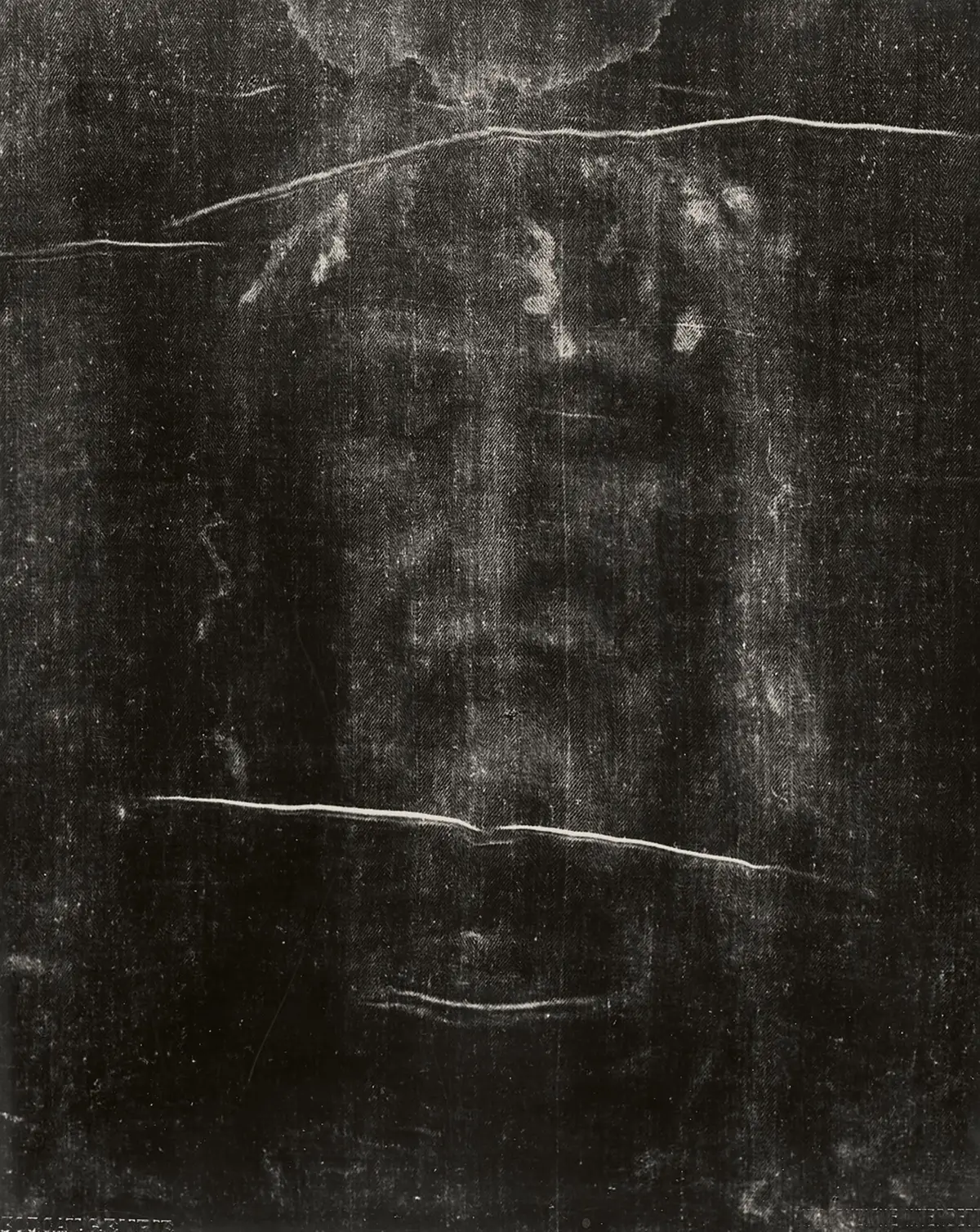
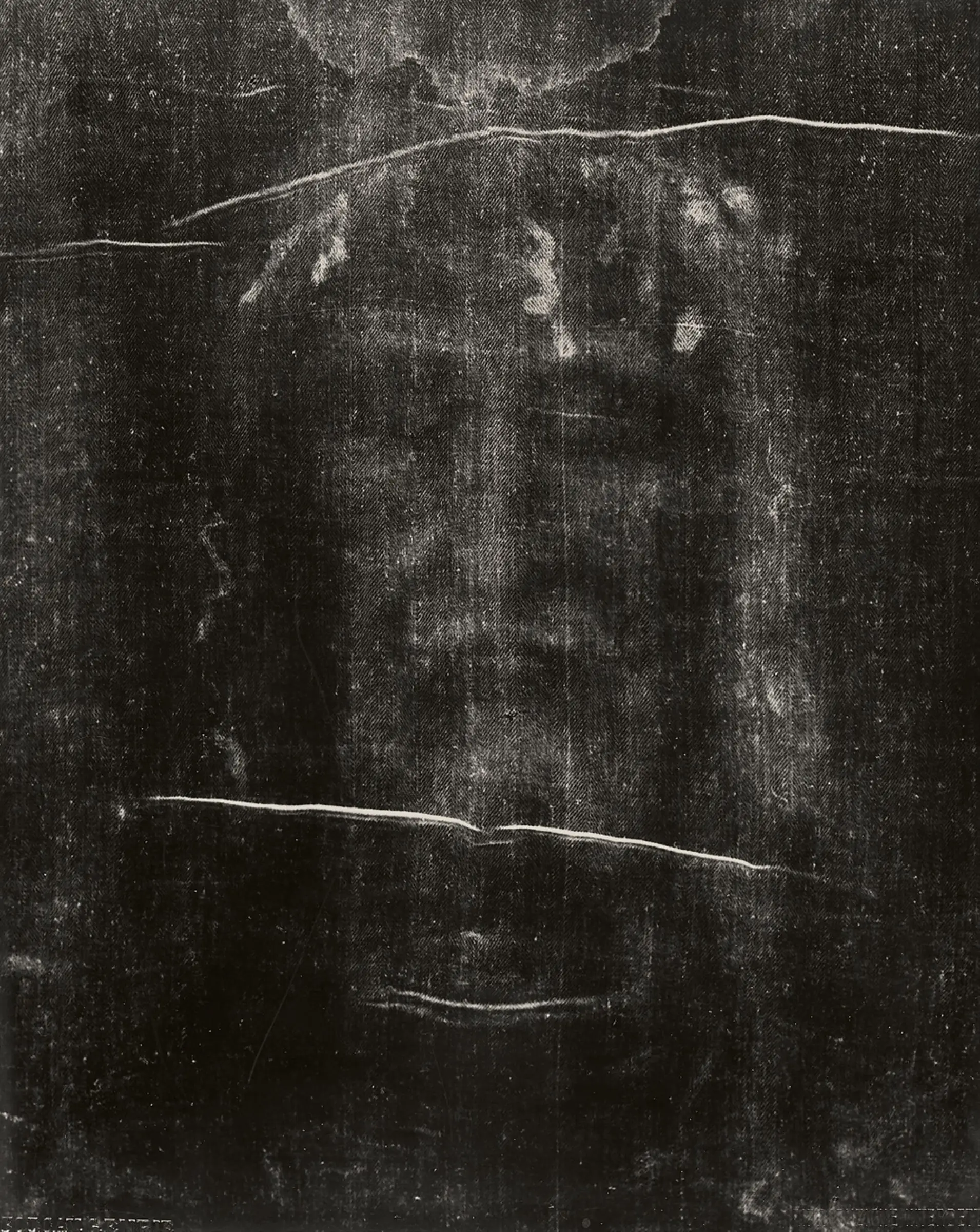
The head. Puncture wounds around the scalp, front and back, with blood flows that ran while the head was upright. On the back of the head the punctures run in a band, which is why forensic readers describe a cap of thorns rather than the circlet of the paintings. The top of the head is not on the cloth. Documented Bucklin
The shoulders. Abrasions across the shoulder blades, read as the weight of a beam carried after the scourging, since the scourge marks there are rubbed. Claimed Bucklin
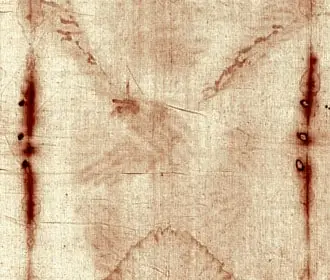
The wrists. The blood flow on the arms runs from a wound at the wrist, not the palm. Almost no painter before the twentieth century put the nails there. Barbet argued from cadaver experiments that a nail through the palm tears out under the body's weight, and that a nail through the wrist (Destot's space) holds and, by injuring the median nerve, pulls the thumb into the palm. The thumbs are not visible on the cloth. Frederick Zugibe, a medical examiner who ran his own suspension experiments with living volunteers, disputed the nerve mechanism and argued a nail through the palm at an angle toward the wrist holds too. Both agreed the wounds are those of a real crucifixion. Contested Barbet Zugibe
The feet. Blood at the soles and across the top of one foot, consistent with a nail through the feet. Only a handful of crucifixion victims have ever been excavated, and only one from the first century: a man named Jehohanan, found in Jerusalem in 1968 with the nail still in his heel bone. Documented Jehohanan
The side. A large stain on the right side of the chest, between the ribs, with a separate watery component, read as a wound made after death, with blood and serum or fluid from the chest cavity. Claimed Bucklin Barbet
The legs. No sign of a break. The image cannot show bone, so what can be said is that there is no sign of one. Documented
Bucklin's summary, in the words of an autopsy report: "The manner of death would be classed as judicial homicide." Claimed Bucklin
Rigor, decay, and what is not there
Forensic readers note that the body shows signs of rigor mortis: the head bent forward, the knees slightly flexed, the feet extended. Claimed Bucklin Zugibe
Two absences are often cited. There are no putrefaction stains, which a body ordinarily leaves on cloth within two to three days unless conditions are very cold. And some readers argue that the clots on the cloth have clean borders, which they take to mean the cloth was not pulled off a wounded body, since dried blood welds itself to fiber and tears. The first absence is documented. The second is an inference by some authenticity writers and is not in the project's own findings. Contested Meacham Heller and Adler
The inference drawn from both, that a body was in the cloth long enough to bleed and gone before it could decay, is the inference the reader is left to make or not make. A skeptic's reply exists and is given on The Case Against: a cloth that never held a body has clean clots and no decay too.
The 2018 bloodstain-pattern challenge
In 2018 Matteo Borrini and Luigi Garlaschelli published a bloodstain-pattern analysis arguing that several of the flows on the cloth, taken together, are inconsistent with any single posture of a crucified or supine body. A 2019 reply disputed their methods and their model. The question is open. Contested Borrini and Garlaschelli
Last checked 2026-10-20.