Why it was not done in 1978
Radiocarbon dating in 1978 meant burning a piece of linen the size of a handkerchief. The custodians refused on conservation grounds. Accelerator mass spectrometry, which needs milligrams, was new; Harry Gove of the University of Rochester asked Turin for a few threads that year and was refused. Documented Gove Marinelli
The 1988 test
Through the mid-1980s a protocol was negotiated among the custodians, the Pontifical Academy of Sciences, the British Museum and seven laboratories. By the time the sample was cut the protocol had been reduced: three laboratories instead of seven, one method instead of two, and the blind controls dropped. Blinding would not have worked anyway: the Shroud's weave could not be matched among the control samples, so the laboratories could tell which was the Shroud. Documented Nature 1989 Gove
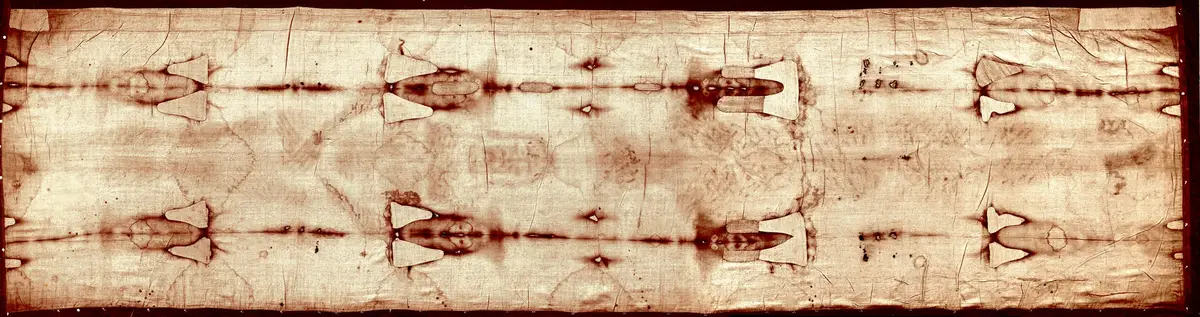
On 21 April 1988 Giovanni Riggi cut a strip about seven centimeters by one centimeter from one corner of the cloth, next to the place Raes had sampled in 1973. The site was chosen that morning by Riggi and Luigi Gonella. The strip was divided among laboratories at the University of Arizona, Oxford University and the Swiss Federal Institute of Technology in Zurich, with control samples of known age. Documented Nature 1989
On 13 October 1988, ten years to the day after the examination ended, Cardinal Ballestrero announced the result in Turin. In the paper published in Nature on 16 February 1989, the three laboratories' combined result dated the linen to AD 1260 to 1390 at 95 percent confidence, "conclusive evidence that the linen of the Shroud of Turin is mediaeval." Documented Nature 1989 SSI 1988
The Cardinal's statement left the evaluation of the result to science. His adviser Gonella said later he had no scientific reason to think the test was inaccurate. Documented SSI 1988 Gonella obit
For most of the public, and for most scientists, that was the end of the question.
The challenges
The challenges fall into three kinds: the sample was not representative, the statistics were not as clean as reported, and other methods give other dates. Each is given here with its reply.
The sample was a repair
In 2000 Sue Benford and Joseph Marino, working from photographs, argued that the radiocarbon corner showed signs of an invisible reweave: a sixteenth-century repair in which new thread was spliced into the old so that it did not show. In 2005 Raymond Rogers, the project's own chemist, who had set out to disprove them, published in Thermochimica Acta that the threads from that corner (Raes's 1973 threads, and material from the radiocarbon trimmings) contained cotton, a dyed gum coating and a chemistry not found in his 1978 tapes from the rest of the cloth, and that the amount of vanillin remaining in the lignin of the main cloth suggested a much greater age. He concluded the sample "was not part of the original cloth." He died seven weeks after publication. Claimed Rogers 2005
The replies. Mechthild Flury-Lemberg, who handled the entire cloth in 2002, says there is no reweave: the corner is the same weave as the rest, and an invisible mend of that kind would be visible from the back. In 2010 Rachel Freer-Waters and Timothy Jull at Arizona examined a leftover piece of their 1988 sample under magnification and reported ordinary Shroud linen with no dye, no coating and no patch. Joe Nickell and others have called the reweave claim unsupported. Claimed Flury-Lemberg Arizona 2010 Skeptical Inquirer
Where this stands: the corner is the most handled part of the cloth, and the one place cotton has been found. Whether that means a repair or contamination, and whether either would shift a date by thirteen centuries, is argued. The mainstream of radiocarbon science has not moved. Contested
The statistics
In 2019 Tristan Casabianca and colleagues obtained the raw 1988 measurements by freedom-of-information request and published an analysis in Archaeometry showing more variation between and within laboratories than the Nature paper's combined result conveyed, and a trend in dates along the length of the strip. They concluded the 1988 result was not reliable enough to settle the question. The authors did not claim a first-century date. Critics reply that the heterogeneity is a precision problem, not evidence for a different century. Claimed Casabianca 2019
Other dating methods
- 2013, Giulio Fanti and colleagues reported mechanical and spectroscopic measurements on fibers of uncertain provenance, giving ranges centered around the first century with very wide error bars. Claimed Chronology
- 2022, Liberato De Caro and colleagues reported a wide-angle X-ray scattering measurement of the cellulose structure of a thread, which they said was compatible with a cloth about two thousand years old if it had been kept within a narrow range of temperature and humidity for thirteen centuries. The assumption is the weakness, and radiocarbon specialists such as Christopher Bronk Ramsey of Oxford have said these are not methods used for dating in archaeology. Claimed De Caro 2022
- Contamination theories (a bioplastic coating, carbon monoxide, smoke from the 1532 fire) have been proposed to explain the 1988 date; none has been shown to shift a date by the amount required. Claimed
DNA
In 2015 Gianni Barcaccia and colleagues sequenced plant and human DNA from dust vacuumed from the back of the cloth in 1978 and 1988. They found many plant species and human mitochondrial lineages, including lineages common in the Indian subcontinent. They wrote that the data were "compatible with both alternative scenarios": a cloth made in India or the Near East and carried to Europe, or one made in Europe and handled by people from many places. Contested Barcaccia 2015 A 2026 study of the 1978 sample archive, reporting handler DNA, storage fungi and post-Columbian plants, has been published and has not yet been reviewed for this site.
Where the question stands
The 1988 radiocarbon date is the single strongest physical measurement for a medieval origin, and it has not been overturned. The challenges to it are real and have been published in peer-reviewed journals; none has been accepted by the radiocarbon community. The custodians have not permitted a second test. Until they do, "we have not established the age of the cloth" is the one sentence both sides can sign. Contested
Last checked 2026-10-20.